
Search the El Cajon Residents Directory
El Cajon sits inside San Diego County, but it is not the county seat. That split shapes every resident lookup. A search can move among the City Clerk and the county Assessor/Recorder/County Clerk. The Superior Court, the Registrar of Voters, and state agencies also hold records. Property clues usually begin with the county assessment roll or the City GIS Hub. Person clues may start with a court party search. A state license or a business entity filing can also lead somewhere. Family history belongs with old street directories, census schedules, newspapers, vital records, and archives.
A records trail can prove a recorded owner. It can prove a case party, a registered voter, or a historical address. It cannot prove someone lives at a home today. Renters rarely show up. Unlisted household members may not appear either. Protected participants stay out of view. People listed under a mailing address elsewhere can also mislead a resident lookup.
- Write down the known name, address, time period, and reason for the search before opening a portal.
- Use the San Diego secured assessment roll or the El Cajon GIS Hub to establish parcel geography.
- Use ARCC’s permitted phone or kiosk channel for ownership, then search the Official Records Index by party and document.
- Check the San Diego Court Index or the relevant state lookup when the clue is a case, license, business, or public filing.
- Move to the library, archive, census, newspaper, or a precise CPRA request when the question is historical or the online record stops.
That order keeps a weak match from steering everything. An APN, a date, a spouse, an occupation, a parcel boundary, or a document number gives the next office something exact to check.
El Cajon Resident Records Offices
ARCC in San Diego County wears three hats. The assessor supplies parcel and value context. The recorder supplies indexed transactions. The County Clerk issues public and confidential marriage licenses and files fictitious business names. Voter rolls belong to the county election office. Case files sit with the Superior Court at the East County Regional Center. El Cajon's City Clerk is the custodian for city ordinances, permits, plans, police, fire, and administrative records.
San Diego County ARCC
Assessor, Recorder, County Clerk
(619) 238-8158 recorder line
San Diego County Assessor
Address and APN assessment search
(619) 236-3771 public information
Registrar of Voters
Personal status and controlled files
(858) 565-5800 information
The office matters as much as the search term. A permit request sent to the county will miss the file, and a county parcel inquiry will never replace a city inspection record. Give the custodian a clear address, APN, date span, department, and requested format. Precision speeds the reply.
El Cajon Residents: Parcel Search Comes First
A parcel often beats a name as the first anchor. The 2026 secured assessment roll accepts a street number and street name. It also accepts a full APN. Results can show the APN, situs address, assessment year and lien date, land and improvement values, and total assessed value. They can also list exemption indicators, factored base-year value, and change or appeal notices. Owner names stay offline under California's home-address publication rule. Treat the roll as a map and value tool, not an open household list.
El Cajon's GIS Hub adds another layer. It maps parcels, zoning, council districts, street sweeping, resurfacing, benchmarks, ZIP layers, and development projects. Select a parcel to save its location and APN. Compare the city boundary against the postal label. Never assume an address falls inside El Cajon from the postal label alone. Ownership and title still require ARCC's phone or kiosk channel. A parcel can also lead to a permit jacket. It may point to a recorded deed or a tax record. None of that proves who occupies the home.
| Address / Location | Text or autocomplete; normalize directionals and street suffixes. |
|---|---|
| Parcel / APN | Text; the research uses a hyphenated pattern such as 123-456-78-90. |
| Permit / Case Number | Exact key when a city planning or building record is known. |
| Record Type | Building, planning, engineering, or enforcement category when offered. |
| Date Range and Status | Use a broad date pair, then narrow by issued, active, final, expired, or cancelled status when available. |
"Situs" means the parcel's physical location. A tax mailing address is simply where correspondence goes. Keeping the two apart stops a street directory search from mistaking an owner's mailing address for a residence.
- Roll
- An assessment listing that describes a parcel, value, exemption, or lien-date detail.
- Index
- A searchable record of recorded parties and instruments; it is not the document image itself.
- Criss-cross directory
- A historical street-and-number listing that can pair an address with a named householder or business.
- Parcel
- A mapped tax unit identified by an APN, which may differ from a building, unit, or household.
El Cajon Residents and the Recorder Deed Index
The ARCC Official Records Index is free to search. It reaches back to 1970. A search returns indexed party names, each party's role, document type, recording date, document or recording number, and book/page references when present. Deeds, deeds of trust, reconveyances, liens, releases, notices, and maps may all appear. The online index shows no document images, which live at ARCC kiosks or come through a paid mailed-copy process.
Start with a current owner or grantee. Then match the instrument to the APN, legal description, vesting, spouse or trust name, and recording date. A grantor conveys an interest. A grantee receives it. The index proves a recorded transaction, not a current resident. AB 1785 removed APN searching from the online recorder search on December 9, 2024, so APN work now stays at five public kiosks. Older deeds take another path. County Archives, books, microfilm, or a targeted genealogy request hold them.
- Party name
- Try surname, organization, trust, spouse, and spelling variants; a match does not prove that the party lives at the parcel.
- Document type
- Separate deeds, liens, releases, maps, and reconveyances; an instrument is not automatically a residence record.
- Recording date
- Narrow common names and build a chronology; it does not establish the date someone moved in.
- Document number
- Use it to request or view the exact image; the index alone does not provide the complete terms.
Owner Alert adds a fraud-prevention layer. One email can watch ten names and ten APNs and receive a document number and index link after a matching instrument records. It never shows document contents or blocks a recording.
El Cajon Ownership by Phone
The online assessment roll has a quirk. It shows the assessed value yet leaves the owner off the screen. That gap is intentional. A lawful personal research question may truly need an owner or a property mailing address. ARCC spells out the phone and public-kiosk routes that remain open. Have the APN ready, plus the exact situs. Bring any subdivision or lot detail, and a clear question. A clerk can walk through access and copying. A phone answer, though, is not an oral identity certification. Treat it as direction, not proof.
Each record type carries its own weight in an El Cajon residents directory search. A permit names whoever applied, owned, designed, or built at the time of the work. A tax record shows billed parcel information. A deed proves a transfer and fixes the legal description. None of them lists every adult under one roof. The strongest residents directory habit is simple. Tie each claim to the record that actually backs it up.
| Source type | Useful for | Limit |
|---|---|---|
| Official rolls and indexes | Custodian-held parcel, party, value, or filing facts | Defined coverage, access rules, redactions, and date limits |
| Commercial people-finder tools | Convenience leads from mixed public and inferred data | May merge names, lag transfers, and lack a verifiable source trail |
Ownership and parcel access options sit on the ARCC property-records page. The county channels work best with an exact address. Broad, unsupported rosters fall outside them. The San Diego County ARCC service hub gathers the phone, map, kiosk, and office paths in one place for property information.
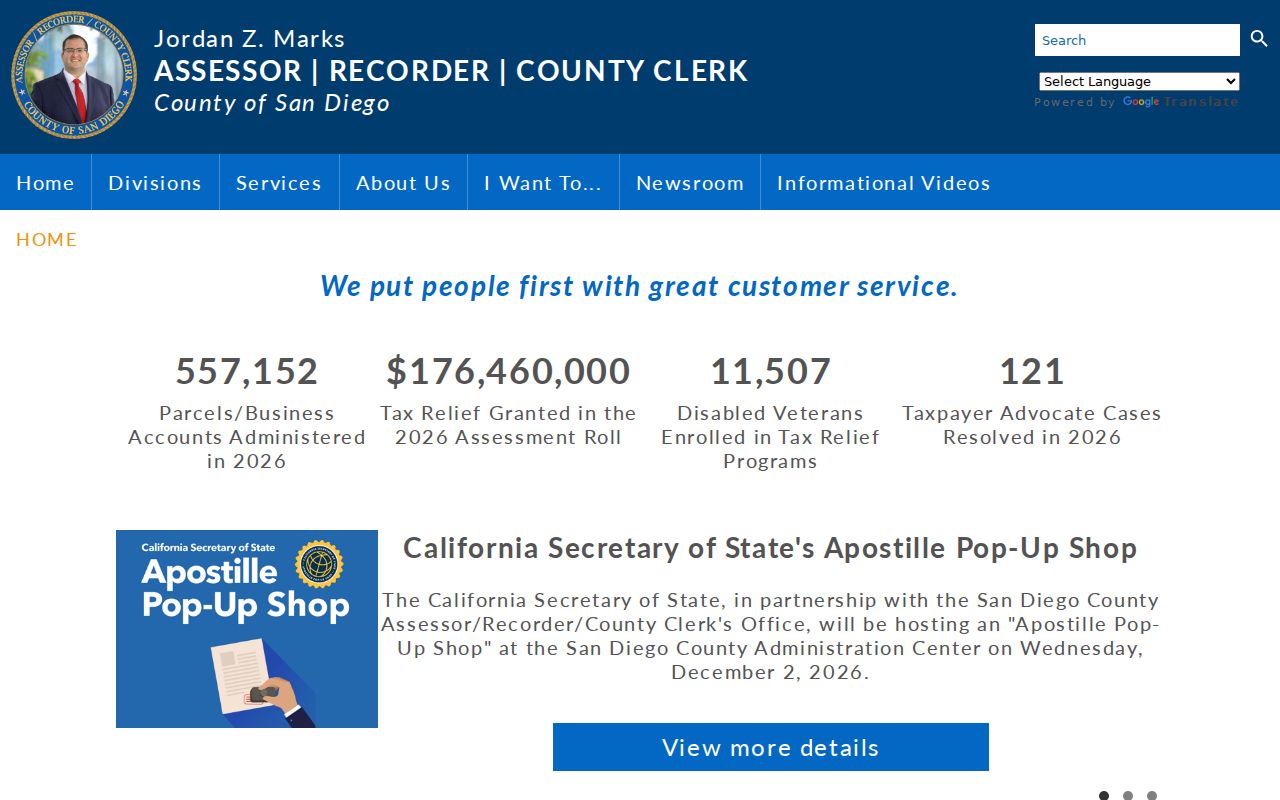
That county service map anchors a practical El Cajon residents directory search. The parcel and deed layers still demand separate reading as distinct strands of evidence.
Current El Cajon Resident Directories
Modern sources work best as focused rolls. Each one has a keeper. Each has an access rule. Each draws a hard boundary on what it can say about El Cajon people. The table separates a property lead from a residence clue, a filed party from a household member, and an official work contact from a private address.
| Source | What It Lists | Keeper | Access |
|---|---|---|---|
| Secured assessment roll | Parcel, value, exemptions; ownership through permitted channel | San Diego Assessor | Address/APN web search; owner phone/kiosk |
| Official Records Index | Parties to deeds, liens, releases, and maps | ARCC Recorder | Free 1970-present index; image kiosk or copy |
| My Voter Status | Authenticated voter’s own status and polling data | California Secretary of State | Personal identifiers required |
| City staff pages | Official work roles and contacts | City of El Cajon | Public web pages |
| Business and license files | Entity, agent, credential, or public discipline details | California agencies | Free focused searches |
Let the question pick the source. A current address inquiry leans on parcel geography and a permitted ownership channel. A family-history question may pull an obituary, an old city directory, a census page, or a probate file. Professional affiliation belongs in a license or business filing, never in a property roll.
Directory and roll results can be stale. They can be redacted, date-limited, or tied to an organization rather than a person. Record the source name, the date checked, the exact spelling, and the record number. That way a later custodian request can be reproduced.
El Cajon Residents: Voter Status Is Personal
California My Voter Status is a personal, authenticated service. It asks for first and last name, date of birth, and either a California driver license or ID route or the last four digits of a Social Security number. The authenticated voter then sees registration status and location, party preference, language preference, polling place, upcoming election details, and vote-by-mail or provisional-ballot standing. It is not a public El Cajon residents directory. It cannot enumerate a street.
Voter-file access is purpose-limited under Elections Code §2194 and 2 CCR §§19001-19013. Qualified requesters apply for a statewide or county file, supplying identity, organization, intended use, security declarations, and a signature. Released fields can include name, residence or mailing address, party preference, registration date, precinct, districts, and participation. Driver-license numbers, Social Security numbers, signatures, and confidential participants stay protected. Voting history shows participation only. Ballot choices never appear.
- First and last name
- Required exact voter-record fields.
- Date of birth
- Required personal authentication field.
- California DL/ID
- One identity route; the form allows a no-number selection.
- SSN last four
- Alternate identity route; both identifiers improve matching.
California My Voter Status is the exact personal entry point. The state voter-file rules explain why a controlled file cannot become an open neighbor list. The authenticated California voter form lays out the personal fields a status check demands.
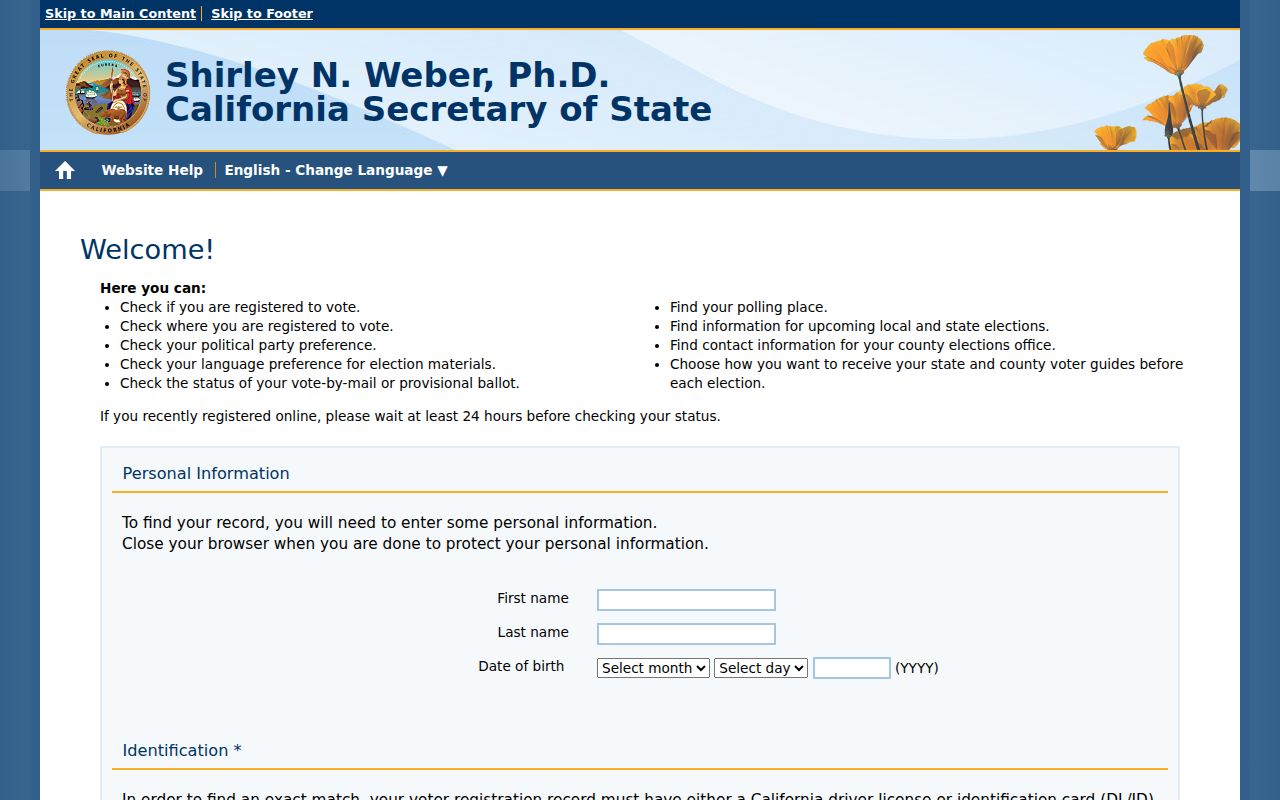
The authentication screen draws the line clearly. A personal record check is never permission to publish or infer the registration details of other El Cajon residents.
El Cajon Resident Court Index Checks
The Superior Court's East County Regional Center at 250 East Main Street handles criminal, family, and civil-harassment and elder-abuse restraining-order matters. Juvenile dependency is covered there too. The public Court Index searches by party name, case number, or DA number. It can surface a case and the filing details the index exposes. Charges and disposition stay out of reach there. Pre-1974 cases, juvenile matters, traffic and minor-offense categories, sealed records, and protected family details need special caution. Some are simply absent.
A court hit is a lead. It is not a conclusion about a person. The clerk's official file or the register of actions reveals role and outcome. A specific document or a certified copy does the same. Federal cases route through PACER for the Southern District of California. It requires an account and charges $0.10 per page, capped at $3 for one document, with the current quarterly fee-waiver threshold applying.
For a current custody question, the San Diego County Sheriff Who's in Jail search is a separate system. It is live. It shows booking and custody fields as available. Absence there never proves the lack of a prior case. A booking is not a conviction. The Sheriff's current custody search stays a focused lookup, not a complete resident record.
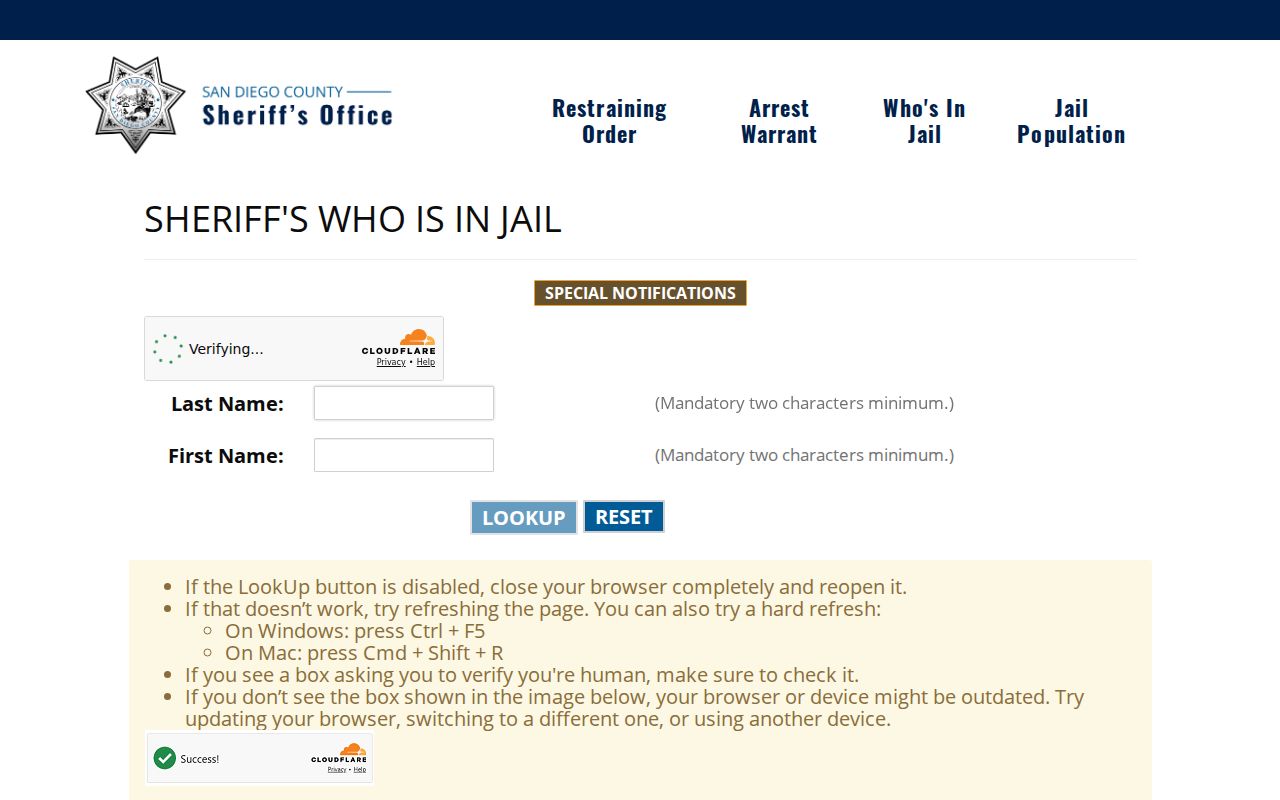
Its narrow purpose carries a wider lesson. Every name search deserves a date, a keeper, and a record-type check before any result earns broader meaning about an El Cajon resident.
El Cajon Resident Vital Record Paths
Vital records for El Cajon split into five separate searches: birth, death, public marriage, confidential marriage, and divorce. Custody is shared. San Diego ARCC and the California Department of Public Health each hold some of these files depending on the record type and year. Statewide birth and death registration starts in July 1905. California also separates copies into informational and authorized classes instead of one simple closed-for-years rule. Anyone may request most nonconfidential informational copies. Authorized certified copies are limited under Health & Safety Code §§103526 and 103526.5.
Confidential marriage records sit behind Family Code §511. Adoption files and original birth records stay sealed unless a statute or a court process opens them. A divorce certificate is not the decree itself. The Superior Court keeps the decree and the complete case file. Mail forms typically ask for the applicant, the relationship or eligibility, the event date and place, names before marriage, parents' names for a birth, spouse names for a marriage, the copy class, a signature, and the fee. Authorized mail requests generally need a notarized sworn statement.
- Birth
- San Diego ARCC or CDPH; authorized versus informational copy. The 2026 fees noted are county $34 and CDPH $31.
- Death
- San Diego ARCC or CDPH; copy class and year rules apply. The 2026 fee noted is $26.
- Public marriage
- ARCC or CDPH; confidential marriage is a separate restricted route. The 2026 CDPH fee noted is $19.
- Divorce
- Superior Court holds the decree, with a limited CDPH certificate route. The 2026 CDPH dissolution fee noted is $18.
Before July 1905, a different route is needed. County registers, church and cemetery records, newspapers, and FamilySearch catalog material cover the earlier era. A vital record proves an event and named relationships. It does not make a person's current residence public.
Historical El Cajon Resident Directories
Historical El Cajon residents directory research is a regional effort rather than a city-only one. San Diego Public Library's California Collection documents city directories from 1886 through 2021. The digitized runs split between San Diego Yesterday for 1887-1925 and City Archives for 1874 plus many 1926-1960 volumes. El Cajon turns up in verified 1930, 1934, 1937, and 1938 sections. The 1955-1960 suburban books offer the strongest documented bridge for El Cajon address-to-name work.
County records reach back to 1850, decades before El Cajon incorporated on November 12, 1912. That timeline changes the label a person appears under. Try county, township, precinct, Rancho Cajon, subdivision, valley, and later city terms in any residents directory search. A directory is a compiled snapshot, not a census-night record. A missing name can reflect a coverage boundary. It can also reflect a move, a spelling variation, or an unlisted household. The El Cajon city directory collections page follows the shelf runs, publishers, entry marks, and household-tracing method in greater depth.
El Cajon Library Directory Shelves
The El Cajon branch at 201 E. Douglas Ave. belongs to San Diego County Library. SDCL names El Cajon and Vista as branches with large reference collections and describes local-history holdings that include photographs, documents, and oral histories. The branch page publishes no El Cajon-only directory shelf years, so reference staff should confirm a catalog or shelf inventory before treating any year as complete.
San Diego Public Library Central Special Collections is the better documented regional fallback. Its holdings include directories, the 1888-1892 Great Register, the San Diego Union from 1868, photographs, more than 800 maps, and Sanborn materials. A research request should name the surname, street, likely year, directory type, and whether a numerical or alphabetical section is needed. Read the front matter and abbreviation key before transcribing names.
A criss-cross directory flips the usual name-first order. Streets appear in numerical or alphabetical sequence, with house numbers running along the block and a listed householder or business beside each number. Marks may flag homeowners, telephone subscribers, widows, spouses, rural routes, or a business address. Those marks are valuable clues. They do not list every adult in a household.
El Cajon Business and License Trails
Some El Cajon lookups concern a person's public affiliation rather than a home. California Secretary of State bizfile Online can return an entity name or number. It also shows status, formation, and jurisdiction. Addresses and agent for service appear too. Filing history and documents may follow where available. A registered agent is a service contact. The agent is not necessarily an owner or resident. The county FBN channel adds trade-name statements. Registrant details come with them. Use both channels when a business name changed over time.
The California Department of Consumer Affairs searches by license type or number. Name and location fields are offered too. Results may show status, issue or expiration dates, public discipline, and an address of record. Contractors, attorneys, educators, and other regulated professions can sit in separate systems. A license address is a professional or mailing clue. It should not be converted into household evidence. The California license search provides the public professional lookup route.
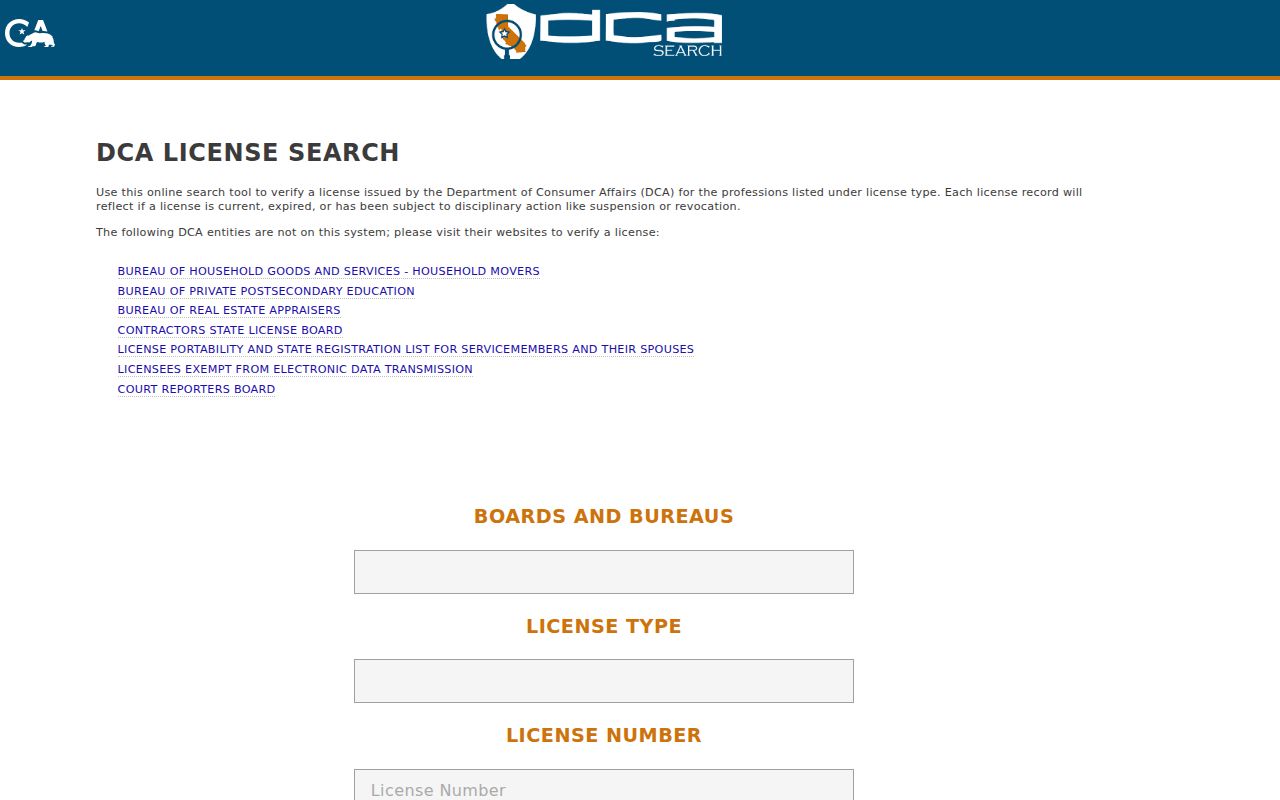
That focused result can corroborate a name, role, or business connection while staying within the record type the agency actually publishes. Bizfile Online supplies the state entity-search route for business names and numbers.
Entity filings help distinguish a company address from a person's residence in the El Cajon residents directory context, and they can point to a better custodian for a records request.
El Cajon Unclaimed Property Leads
California's unclaimed-property search, run by the State Controller, accepts a last name or business name along with first name, middle name, city, and ZIP. A hit may surface an older owner name, a location fragment, a holder, a property ID, or a property type. Claiming the money takes proof of identity and ownership. Treat a match as a historical lead. It is not a current residence check. A stale address can linger in the file long after someone moves.
The tool earns its keep when a surname is uncommon or a family-history search needs a second location clue. Cross-check the result against a directory, an obituary, a deed, or a business filing. Start at the official state search. Ignore unsolicited recovery demands. Searching and claiming through the State Controller are free. The California unclaimed-property search lays out the name-and-location fields the state uses.
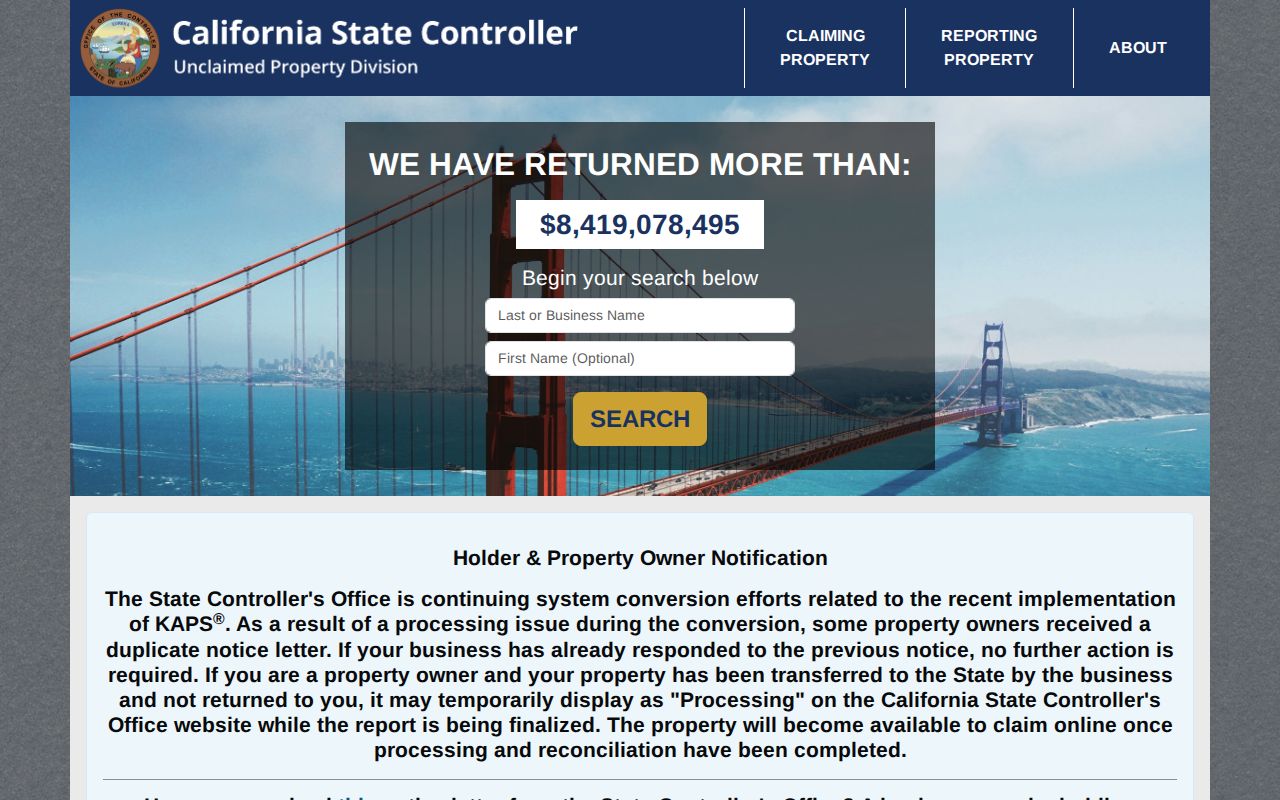
A name match justifies a follow-up record check. It never proves an owner lives in El Cajon now. The California service description explains the official state route to search and claim.
El Cajon Public Record Requests
The El Cajon City Clerk is the fallback for any municipal record not posted. Request routes are labeled General, Police, Fire, and Property. Pick one route. When several departments are involved, city guidance says to file a single General request instead of duplicates. Submit through the city channel, email, mail, or in person. The form asks for name, phone, email, record type, subject property address, description, desired delivery, and a signature.
Vague requests stall. Name the department, the date span, an address or APN, a project or permit number, and a preferred electronic format. Ask for a permit history, an inspection status, or a releasable permit jacket rather than "all records about a person." Building and planning files can name an applicant, owner, architect, or contractor at the time of work. Code-enforcement files show an address and case chronology. Complainant details and active-investigation material can be withheld.
The California Public Records Act, Government Code §§7920.000 et seq., usually gives an agency ten calendar days to decide disclosure. Unusual circumstances allow a fourteen-day written extension. Inspection is normally free. Direct duplication costs may apply. A request never obliges the city to build a new residents directory or hand over exempt personal information.
El Cajon Privacy and Opt-Outs
Privacy barriers shape any accurate El Cajon residents directory search. Safe at Home is the big one. California's program gives covered survivors and protected public workers a substitute address. Government Code §§6205-6211 and related rules bar publishing participant addresses, phones, and images. Voter identifiers, signatures, Social Security numbers, motor-vehicle data, and protected court details can be withheld too.
The California Consumer Privacy Act, Civil Code §§1798.100 et seq., gives covered consumers rights to know, delete, correct, limit sensitive-information use, and opt out of sale or sharing. The 2026 DROP framework lets one deletion or opt-out request reach registered data brokers. The Attorney General reported the tool reaches more than 500 of them. Use the official channel. Verify only what is needed. Keep the confirmation.
A wrong record goes back to its custodian. A commercial compilation can merge same-name people, lag a transfer, or infer a relationship. It cannot override an official suppression rule. Family history, estate work, civic curiosity, and scam avoidance fit. Stalking, harassment, intimidation, and threats do not.
El Cajon Records Across Time
El Cajon's record story is one of shifting custodians and labels. Rancho Cajon was granted in 1845. Lankershim interests acquired much of it in 1868. Amaziah Knox built a hotel and residence at Main and Magnolia in 1876. The city incorporated in 1912, after 123 of 158 electors approved a 1.25-square-mile city. Population growth and annexation kept changing the place a directory, permit, or postal line described.
County Archives reports official-record holdings from 1848-1959, historic birth and death material from 1849-1986, marriage material from 1856-2020, maps from 1854 forward, and administrative series from 1881-2011. The spans are deep. Those older holdings sit beside the modern ARCC index, the city GIS Hub, court files, library shelves, and state systems. Keep date and jurisdiction visible.
"El Cajon" can mean the incorporated city, a postal area, the historic valley, or El Cajon Boulevard in the City of San Diego. A near-match can belong to another jurisdiction. Check the map, custodian, date, and record type first. Then add it to the El Cajon residents directory.